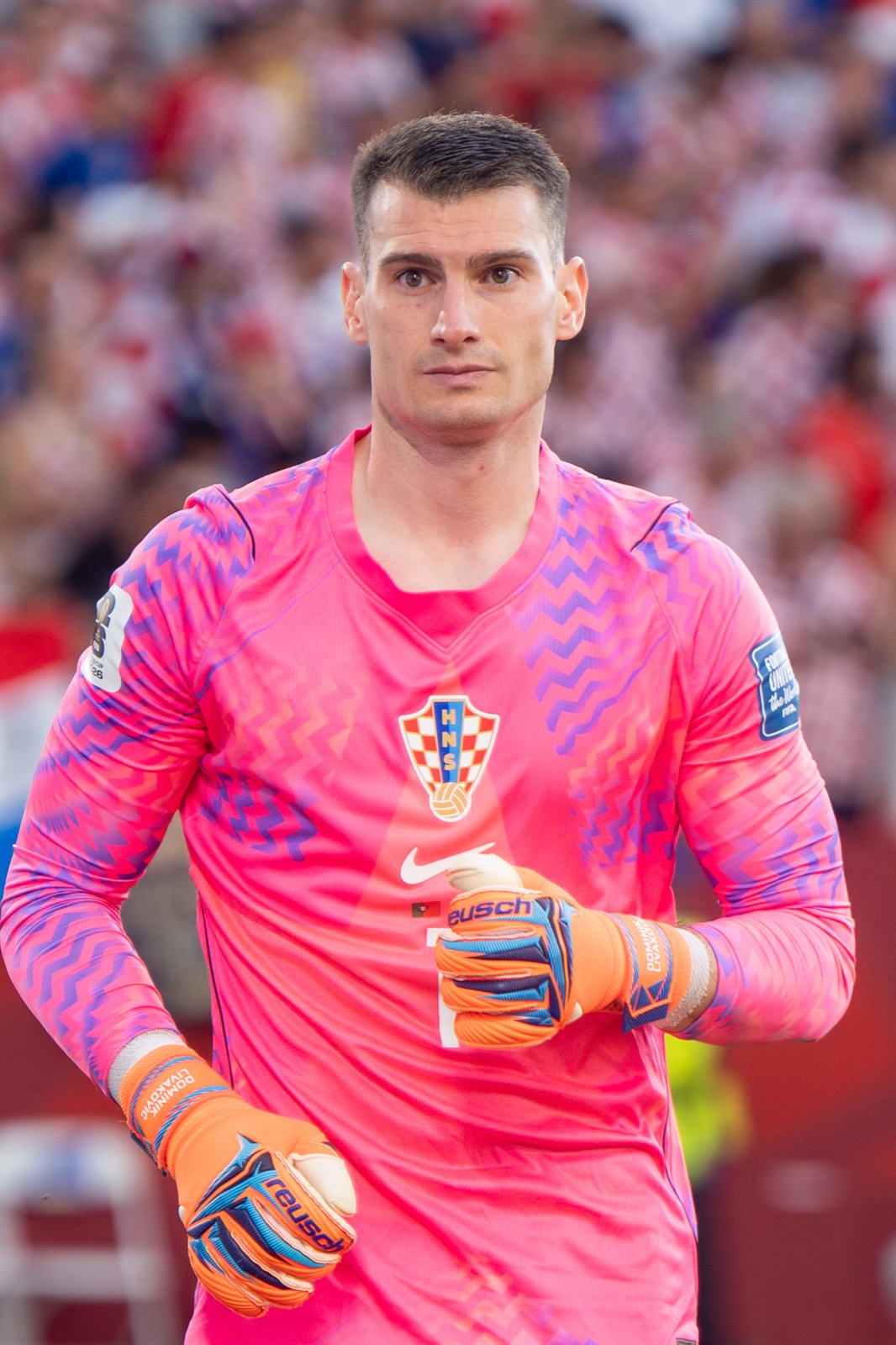
FC Barcelona announced the signing of Dominik Livaković from Fenerbahçe SK on 27 August 2026: a four year contract, running to 30 June 2030. The statement is unambiguous and already calls him a new blaugrana player. What it does not say is whether the Croatian goalkeeper will be able to take the field, because in Spain signing and registering are two separate acts, and the second one turns on a number the club does not set by itself.
The deal in brief
| Item | Detail |
|---|---|
| Player | Dominik Livaković, 31 |
| Position | Goalkeeper |
| From | Fenerbahçe SK |
| To | FC Barcelona |
| Type | Permanent transfer |
| Contract | Four seasons, until 30 June 2030 |
| Fee declared by the club | None |
| Registration status on 27 August | Not yet registered with LaLiga |
Four seasons to 2030, and not a single figure
The official text says that Barcelona and Fenerbahçe reached an agreement for the transfer of Livaković and that the Croatian goalkeeper signs for four seasons, until 30 June 2030. From there the statement runs through his career and stops: no fee, no add-ons, no release clause, no quotes from directors, no shirt number.
The sums doing the rounds are journalistic reconstructions, and they do not even match one another. La Voz de Galicia, with the Colpisa agency, reports two million euros fixed plus two million more in variables. MARCA, on the same day, writes that the deal was closed at two million fixed plus half a million in variables. The fixed part is the same, the bonuses are not: the four million version is the one carried by the greatest number of outlets, while the half a million in variables remains, for now, MARCA’s reconstruction alone.
In Spain, a signature is not a registration
This is not custom and practice, it is a written rule. Article V.5.3 of the Reglamento General de LaLiga establishes that no player may take part in professional competitions unless, before the definitive licence issued by the Real Federación Española de Fútbol, he has obtained the prior visa issued by LaLiga. That visa is not a rubber stamp: it depends on the club’s accounts.
Relevo, on the day of the announcement, summed it up in a line: signing a player does not guarantee he can compete, because to register him the club has to fit inside the salary limit the competition sets for it. It is the reason why in Spain an August announcement and a debut can be weeks apart.
As of 27 August, Barcelona had not registered Livaković. MARCA, reporting on the signing, wrote that the club was still waiting to know exactly where it stood on financial fair play before confirming the goalkeeper’s place on the bench, and that if his wage packet did not fit he would go out on loan elsewhere.
Who sets the ceiling, and what goes under it
The number is not the club’s to choose. Every club submits its budget to LaLiga and proposes its own límite de coste de plantilla deportiva, the squad cost limit; LaLiga’s Órgano de Validación then approves it or adjusts it to the amount that guarantees the club’s financial stability. Asking for a limit, moreover, does not mean spending all of it.
That limit is not made of wages alone. LaLiga’s official transparency page lists fixed and variable pay, social security, collective bonuses, acquisition costs including agent commissions, and amortisation, meaning the transfer fee spread across each year of the contract. That is the detail that puts this case in proportion: if the press reconstructions are right, two million spread over four seasons would weigh half a million a year in amortised fee, plus the wage. Barcelona’s problem would not be Livaković, it would be the rest of the squad.
A player who has signed and is not registered still counts
Here is the step almost nobody explains. A player under contract with the club but not registered with LaLiga does not drop out of the calculation: the Normas de Elaboración de Presupuestos classify him as plantilla deportiva inscribible no inscrita (articles 38.1.c and 38.2), and article 93.1 requires that the cost of the registrable squad never at any moment exceed the assigned limit, save for the special cases the Normas themselves list, article 100 among them. From the day he signed, in other words, Livaković is already consuming salary room while being unable to play.
Having room is not enough either. Article 99.2 also requires that the budget has been accepted and validated by the Órgano de Validación, that the financial information is up to date at the date of the application, and that the player’s annual cost has been uploaded to the LALIGA Manager platform, under the club’s sole responsibility. A filing error blocks a deal just as effectively as a hole in the accounts.
Sixty per cent, not the one for one rule
The press almost always calls it the 1:1 rule. The regulation in force, in the version of the Normas de Elaboración de Presupuestos updated on 19 November 2025, says something else. A club in excess of its limit, meaning a negative difference between the assigned ceiling and the squad cost (article 100.1), is not frozen out completely: it can register up to the capacidad de inscripción generada. For operations carried out in the seasons from 2025-26 to 2028-29 the Disposición Transitoria Segunda derogates from article 100.1 and sets that capacity at 60 per cent of the cost reduction the club manages to generate through sales, terminations or renegotiated contracts, plus 20 per cent of the net profit on player transfers. The two percentages rise to 70 and 35 per cent when the departing player accounted for at least 5 per cent of the initial squad cost and the new contracts are signed before the summer window closes.
The other routes to raising the ceiling are listed in Title III of the same rules, and they are exhaustive: selling the federative rights of players, capital gains on fixed assets other than players, an increase in the price of broadcasting rights, new commercial contracts, higher season ticket income, contributions received by the club, use of accumulated equity, and an advance authorisation to increase the limit.
What Barcelona’s current ceiling actually is, though, nobody outside the club and LaLiga knows. The most recent document on the transparency page covers the 2025-26 season and was uploaded on 3 March 2026: it assigned the blaugrana 351.284 million euros in September 2025 and 432.807 million in March 2026, with Real Madrid on 761.226 million in both readings. The 2026-27 limits had not been published.
A goalkeeper who has yet to play in Spain
Livaković, 31, born in Zadar on 9 January 1995, arrives with a career that the Barcelona statement sums up in its own numbers: 295 matches in seven seasons at Dinamo Zagreb, 249 goals conceded, 137 clean sheets and seven Croatian titles, then 74 appearances in two seasons at Fenerbahçe with 24 clean sheets. Other sources give different totals for the Dinamo years (293 in encyclopaedic entries, 310 according to MARCA): the figures quoted here are the club’s. For Croatia he has 79 caps as of 2 July 2026, three World Cups and two European Championships, with silver in 2018 and bronze in 2022. On signing, MARCA reports, he said it was a dream to be there and to join Barça.
His Spanish chapter, on the other hand, is still blank. In the summer of 2025 he joined Girona on loan, and the Barcelona statement puts it bluntly: he did not end up playing a single minute. On 30 January 2026 he returned to Dinamo Zagreb on loan, playing 15 matches with 10 goals conceded and 8 clean sheets, and winning another league title.
In goal, Hansi Flick’s Barcelona have Joan García, number 1, and Wojciech Szczęsny, number 13. Marc-André ter Stegen has been on loan at Ajax since 4 August 2026, Áron Yaakobishvili at Almería since 20 August. The team had started with two wins from two, 5-0 away at Elche on 23 August and 2-0 against Athletic Bilbao on the 27th, the day of the announcement: seven goals scored, none conceded.
What to watch now
A date and a fork in the road. The date is the close of the Spanish window, Tuesday 1 September at 23:59 according to the Spanish press: anything not registered by then, if it comes from another club, waits for the winter window, which opens on 2 January 2027.
The fork has two publicly discussed routes and a third written only into the rules. The first is that the club generates registration capacity, through a sale or one of the Title III routes, and registers the goalkeeper. The second is a loan, flagged by the reporting on announcement day as the fallback. The third is the uncomfortable one: article 99.2 states that if a contract is not registered for reasons attributable to a club that lacks sufficient capacity, and the parties then terminate it, that club may not register new contracts with that player until the following window, and specifically not as a free signing. Another club, by contrast, could sign him immediately. It is an anti avoidance rule, and it explains why in LaLiga a transfer announced as done is never quite the end of the story.
Sources: official FC Barcelona statement of 27 August 2026, LaLiga transparency page on the límite de coste de plantilla deportiva, Reglamento General de LaLiga (article V.5.3) and Normas de Elaboración de Presupuestos de Clubes y SADs in the version dated 19 November 2025, LaLiga’s official document on the 2025-26 cost limits, public encyclopaedic entries and statistical archives, MARCA, Mundo Deportivo, La Voz de Galicia, Relevo. The club statement contains no figures: the amounts quoted are press reconstructions and they do not agree with each other.
Frequently asked questions
What contract has Dominik Livaković signed with Barcelona?
Four seasons, until 30 June 2030. That is what the official FC Barcelona statement of 27 August 2026 says: an agreement reached with Fenerbahçe SK for the transfer of the Croatian goalkeeper, who is already described as a new blaugrana player.
How much did the transfer cost?
The club statement contains no figure at all: no fee, no add-ons, no release clause. The amounts in circulation are press reconstructions and they do not agree with each other. La Voz de Galicia, with the Colpisa agency, reports two million euros fixed plus two million in variables; MARCA, on the same day, reports two million fixed plus half a million in variables.
Why can a player who has signed be unable to play in LaLiga?
Because signing is not registration. Article V.5.3 of the Reglamento General de LaLiga states that no player may take part in professional competitions unless, before the definitive licence issued by the Spanish federation, he has obtained the prior visa issued by LaLiga. That visa depends on the club fitting inside its squad cost limit.
What is the límite de coste de plantilla deportiva, and who sets it?
It is the maximum amount a club may consume on its squad during the season. Each club proposes its own limit to LaLiga along with its budget, and LaLiga's Órgano de Validación either approves it or adjusts it to the figure that guarantees the club's financial stability. It covers fixed and variable wages, social security, collective bonuses, acquisition costs including agent commissions, and the amortisation of transfer fees.
Does a player who has signed but is not registered still count against the limit?
Yes. LaLiga's budgeting rules classify him as plantilla deportiva inscribible no inscrita (articles 38.1.c and 38.2), and article 93.1 requires that the cost of the registrable squad never exceeds the limit assigned, save for the special cases the Normas themselves list, article 100 among them. From the day he signs, his cost is already in the calculation even though he cannot play.
What happens if Barcelona cannot register him?
Spanish reports on 27 August pointed to a loan to another club as the fallback. There is also the case covered by article 99.2: if the contract is not registered for reasons attributable to the club, which lacks sufficient registration capacity, and the parties then terminate it, that club may not register new contracts with that player until the next window, and specifically not as a free signing. A different club, however, could register him straight away.