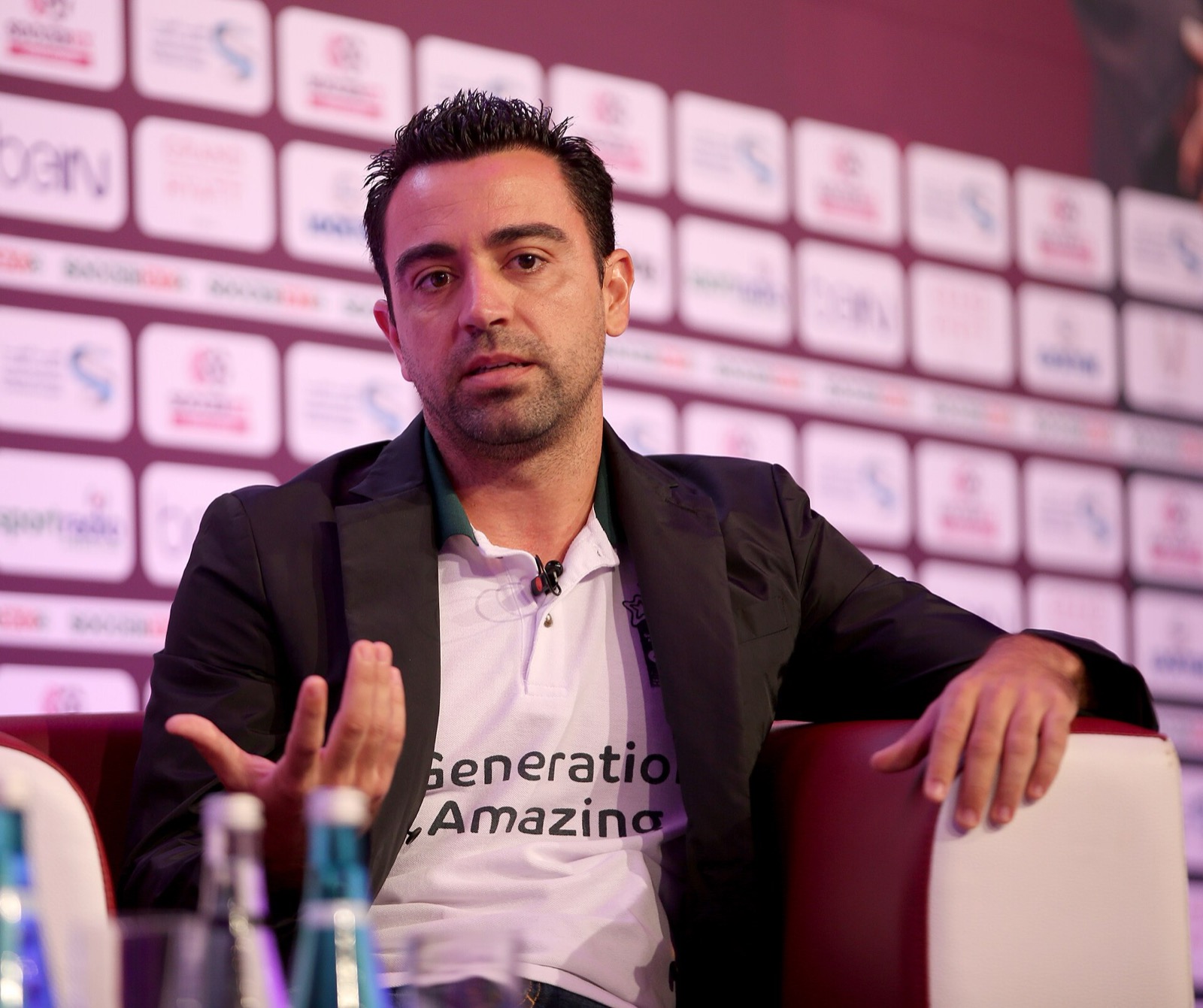
Xavi Hernández is forty-six, has a Netherlands contract that runs to 2030 and roughly forty training days a year in which to persuade a team to play the way he thinks. The Dutch federation announced the appointment on Thursday. It is the first international job of his coaching career.
The picture at a glance
| Item | Detail |
|---|---|
| New head coach | Xavi Hernández, 46 |
| Contract | to 2030, a World Cup horizon |
| Predecessor | Ronald Koeman, resigned 30 June 2026 |
| Reason for the exit | elimination in the round of 16 against Morocco |
| Result | 1-1 after extra time, 3-2 on penalties |
| Xavi’s previous jobs | Al-Sadd (two seasons), Barcelona (three years) |
| International experience | none as a coach |
Where the idea he brings actually comes from
It is worth saying straight away, because it changes the meaning of the news: what looks like a Spanish idea imported into the Netherlands is, at its root, a Dutch idea exported to Spain.
The thread runs through Johan Cruyff, who as a player carried the football of the 1970s Ajax to Barcelona and as a coach turned it into a school of method. Xavi grew up inside that method, first as a boy at La Masia and then as the midfielder of a team that took it to its highest degree of finish. When he arrives in Amsterdam to work, he is not bringing a foreign body: he is taking home something that set off from there.
That guarantees nothing. But it explains why the Dutch federation could pick him without the choice sounding like a betrayal of its own tradition.
What positional play actually demands
The phrase gets repeated often and understood rarely, so it is worth taking apart into its concrete pieces.
The first is the occupation of space. The pitch is imagined as divided into vertical lanes and horizontal lines, and the rule is that two teammates never stand in the same box. The purpose is to guarantee that whoever has the ball always has at least two options at different distances, one short and one long.
The second is superiority in build-up. You play out from the back with one man more than the number pressing you: if the opponent attacks with two forwards, you build with three. This is not an aesthetic quirk, it is applied arithmetic, because a press only works while each of its players has somebody to cover.
The third is the third man. The ball almost never travels straight to the marked player: it goes to a teammate who acts as a wall, and the real target receives it turned and free. That is the mechanism that makes possession dangerous rather than merely circular.
The fourth, the least discussed, is what happens when the ball is lost. A team spread properly across the pitch is already arranged to counter-press immediately, because the distances between players are short by construction. Possession, read this way, is also a defensive tool.
The calendar problem
Here lies the point that makes this job different from every one Xavi has had before.
A club coach sees his squad every day. The automatisms positional play requires, the ones where a full-back knows without looking where the midfielder will be in two seconds, are built by repetition, and repetition means daily sessions over months.
A national coach gets camps of a few days, spread across windows separated by weeks, with players who have in the meantime practised fifteen other systems at their clubs. Time on the training pitch, across a year, is measured in dozens of hours, not hundreds.
National teams that acquire a recognisable identity almost always do it in one of two ways: either by reducing the idea to a handful of very simple principles repeated to the point of boredom, or by leaning on a block of players who already share a language because they play together at a club. It will be interesting to see which road is taken by a coach who, in club football, was used to being able to ask for everything.
What changes from Koeman
The inheritance is a cycle that ended badly and in the worst manner: ahead until the closing minutes, pegged back, knocked out on penalties by Morocco in the round of 16 in Monterrey. Koeman was criticised for a structure judged too careful, and that criticism followed him out of the door.
The direction of the change is therefore legible: from a manager of situations to a coach of declared method. The mirror-image risk, though, exists, and it is honest to name it. An idea that asks for a lot of training, applied where training is scarce, can produce a team that keeps the ball without doing anything with it. That is how positional play fails when it fails: not with a hammering, but with sixty per cent possession and no chances.
What to watch from here
Three things, and the first squad list will already show them.
The first is how many players from the same club get called up together: it is the most reliable clue as to how far Xavi wants to lean on automatisms that already exist. The second is who plays in front of the defence, because in this way of attacking the deep-lying playmaker is the point where a team breathes or suffocates. The third is how many men stay behind the ball when the team attacks: it tells you, better than any statement, how much risk he has decided to take.
The rest is time. On paper, until 2030, there is plenty of it: the first ten matches will determine whether the project survives long enough to spend it.
Data and information gathered from public sources: official communications from the Dutch federation, international sports press, archives of national team competitions.
Frequently asked questions
Why did the Netherlands change head coach?
Ronald Koeman resigned after elimination in the round of 16 at the 2026 World Cup, on penalties against Morocco following a 1-1 draw after extra time. His approach had been widely judged too cautious.
How long is Xavi's contract?
The agreement with the Dutch federation ties him to the national team until 2030, meaning through that year's World Cup. It is his first job in charge of a national side.
What is positional play?
A way of attacking built on the ordered occupation of space: players distribute themselves across vertical lanes and horizontal lines so that a free teammate always exists, and the ball circulates to move the opponent rather than to beat him by force.
What had Xavi coached before?
Al-Sadd in Qatar for two seasons and Barcelona for three years, where he won the Spanish league in 2022-23. He had never managed a national team.
Why is a style of play harder to install at international level?
Because a national coach has only a handful of training days per year, while the automatisms of positional play are built through daily repetition. It is the central constraint on the job.