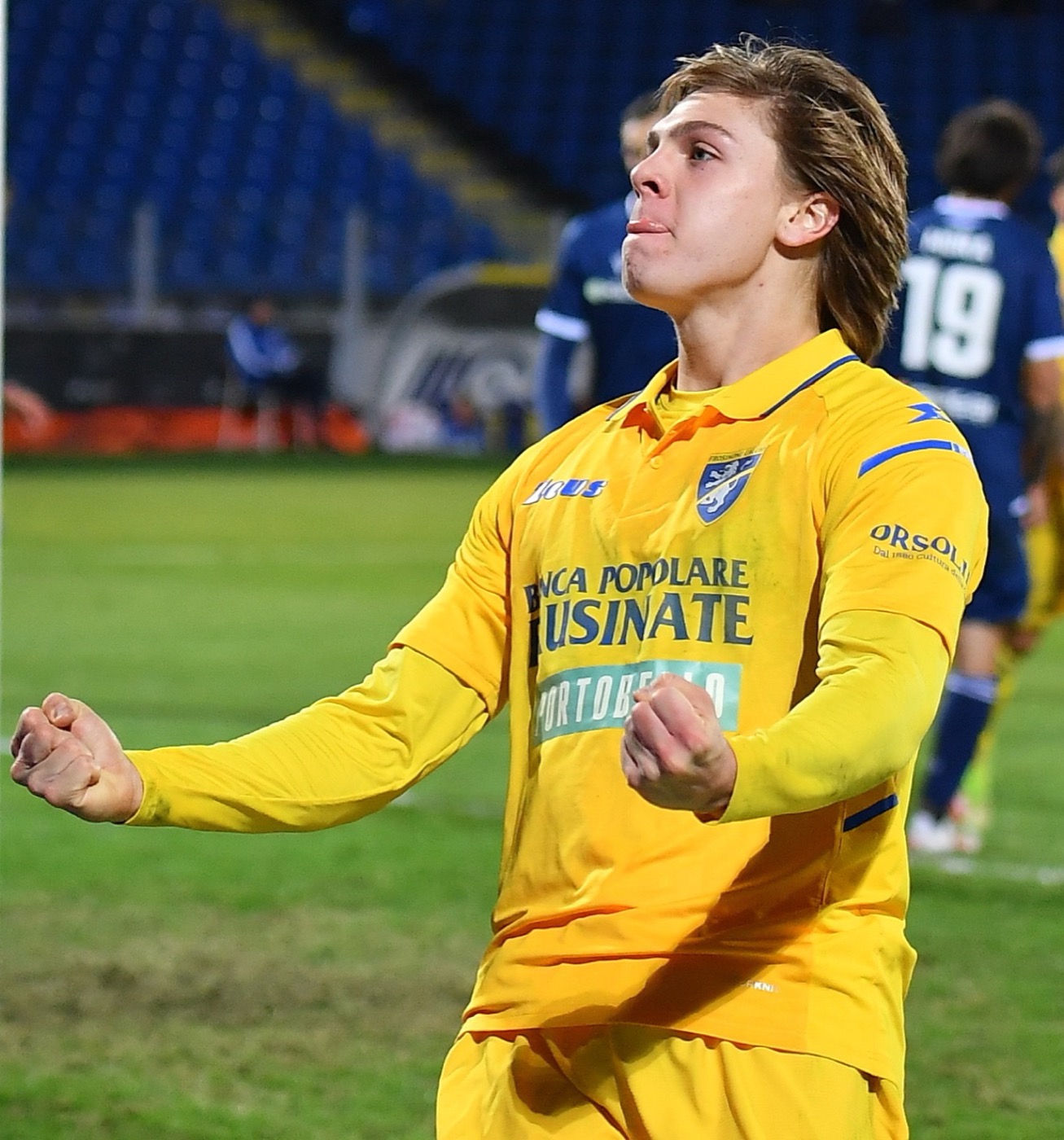
Alessio Zerbin is back at Frosinone, where he had already spent a season on loan four years ago. In between lie nine years on Napoli’s books and six different clubs. The permanent move, alongside that of Luis Hasa, closes a path worth examining not as transfer news but as a development model: the career built on hire.
The path in numbers
| Item | Detail |
|---|---|
| Player | Alessio Zerbin |
| Born | 1999 |
| Position | Wide forward |
| At Napoli since | 2017 |
| Loan spells | Viterbese, Cesena, Pro Vercelli, Monza, Venezia, Cremonese |
| Previously at Frosinone | on loan in 2021-22 |
| 2026 move | Frosinone, permanent |
How the model works
Serial loaning comes from a concrete need. A club near the top signs a promising young player, but the first team has no room to develop him: every minute given to a twenty-year-old is a minute taken from a starter paid to win now. The solution is to send him elsewhere, where he will actually play, while keeping control of his registration.
On paper everyone wins. The parent club protects its investment and follows the player’s growth at someone else’s expense. The host club gets a player from a higher level at reduced cost. The player banks real minutes instead of training well and playing little.
The question is what happens when the arrangement repeats for six seasons.
What it builds
The clearest benefit is adaptability. A player who in six years has moved through the third tier, the second tier and the top flight learns to read different environments, to earn acceptance in new dressing rooms, to produce under different kinds of pressure. Those are real competences, they matter in football, and a player who has only ever known one setting does not develop them in the same way.
There is also a form of mental resilience. Starting from scratch every year, having to convince a coach who did not pick you, earning a place in a hierarchy already formed: anyone who survives that arrives at twenty-five with a hardness that cannot be coached.
What it costs
The cost is continuity of system, and it is a tactical cost before it is a psychological one.
A wide forward at a third-tier side that defends deep and counters does not do the same job he would at a top-flight side that keeps the ball and attacks the opposition half. In the first case he has to run into space, in the second he has to receive between the lines with a defender on his back. Those are two different trades under the same positional label.
Changing every year means never bedding in the patterns that take two or three seasons in the same system to form: the coordinated movement with the full-back behind, the timing of the midfielder’s run, the shared read of when to press. Those things are learned through repetition, and repetition requires time in one place.
The end risk is producing players who are competent everywhere and indispensable nowhere.
Frosinone’s reading
The Lazio club’s choice follows a recognisable logic. Its stated line is young players with potential alongside players ready for Serie A, with a squad built sustainably. Zerbin and Hasa answer both descriptions: one brings the experience of six different leagues, the other is a 2004-born midfielder from the Juventus academy who has just debuted for Albania.
What separates this from the previous moves is the permanent deal. For the first time since 2017, Zerbin is nobody’s guest, and the season ahead is not a trial year to be renegotiated in June.
What the case tells us
Serial loaning is neither an abuse nor a shortcut: it is a tool that works as long as it stays a tool. A year or two away builds a player. Six consecutive years equip him to adapt, which is a different thing from growing him in a defined direction.
The open question left by Zerbin’s case concerns what happens now. At twenty-seven, settled somewhere for the first time, we will see whether the fragmented path was an investment now paying off or the reason the definitive step never came. It is the same question, ten years early, facing every young player leaving on loan this summer.
Sources: official club communications, national and local sports press, public transfer archives.
Frequently asked questions
What is serial loaning in football?
It is the model whereby a club signs a young player and sends him out to play elsewhere for consecutive seasons while retaining his registration. It is designed to develop the player through real minutes without taking up a first-team place.
How many loan spells has Alessio Zerbin had?
Since joining Napoli in 2017 he has been loaned to Viterbese, Cesena, Pro Vercelli, Monza, Venezia and Cremonese. In 2026 he joined Frosinone permanently, a club where he had already spent the 2021-22 season on loan.
Does loaning help or hurt a young player's development?
It delivers real minutes in competitive settings that a first team would rarely provide. The cost is discontinuity: changing club every year means changing system, role and tactical demands, without ever bedding in shared patterns.
Who is Luis Hasa?
A midfielder born in 2004 who came through the Juventus academy and moved permanently from Napoli to Frosinone in July 2026. Born in Italy and raised in the Italian youth setup, he made his debut for Albania in June 2026.
Why is Frosinone targeting these profiles?
The club's stated line is young players with potential alongside players ready for Serie A, with a squad built sustainably. These profiles combine accumulated experience and room to grow at contained cost.