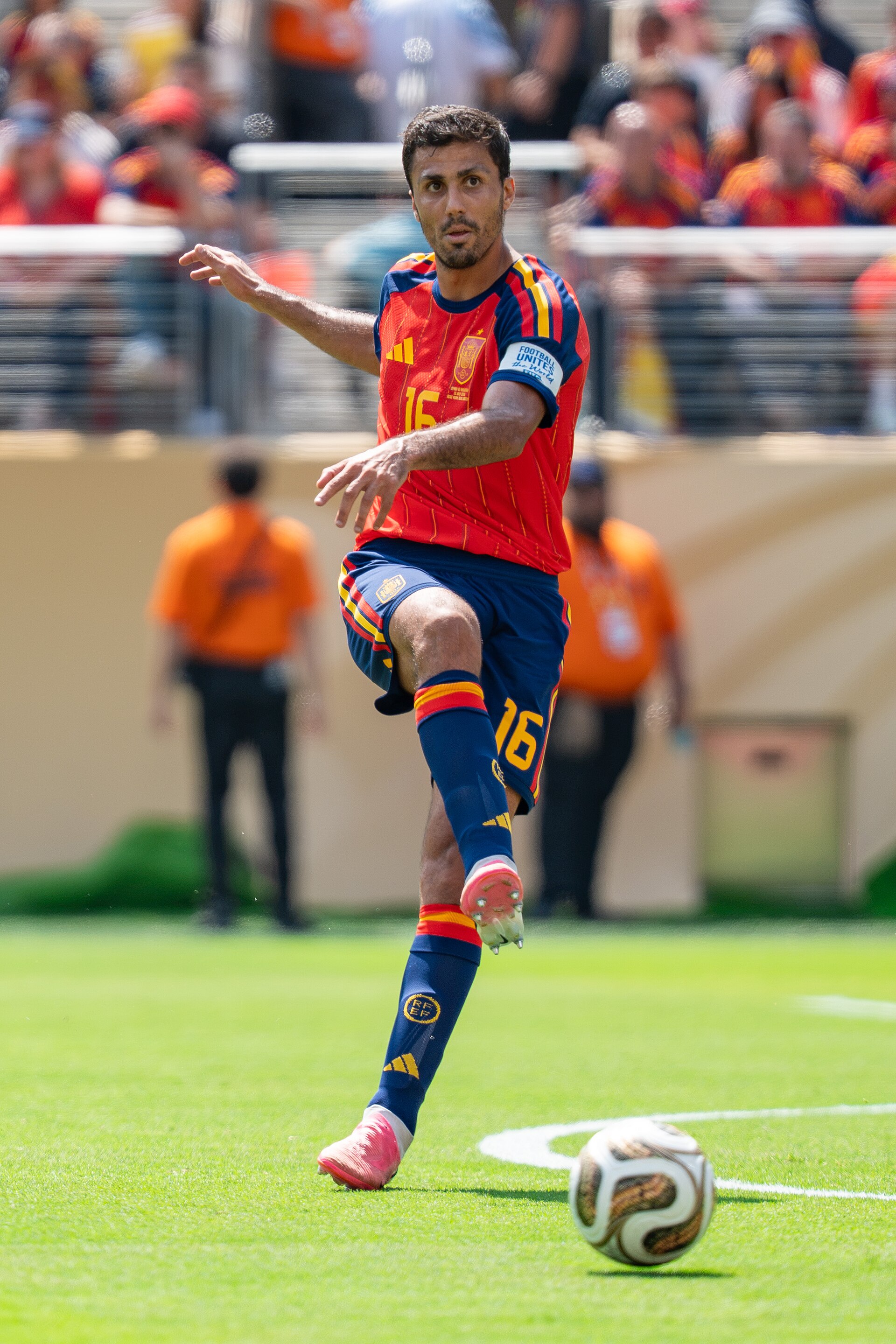
Rodri has left Manchester City after seven seasons and is a Barcelona player, on a contract the club has announced until 2030. The deal, reported at around 76.5 million euros between fixed fee and add-ons, arrives in an unusual week: Barcelona have not yet played their opening league match, postponed because of their players’ involvement at the World Cup. There is time, then, for a question the transfer market rarely asks: what changes on the pitch.
The player at a glance
| Item | Detail |
|---|---|
| Player | Rodrigo Hernández Cascante, known as Rodri |
| Born | 22 June 1996 (30) |
| Position | Holding midfielder |
| Height | 1.90 m |
| From | Manchester City (since 2019) |
| To | FC Barcelona |
| Contract | until 2030 |
| Honours | Ballon d’Or 2024, player of the tournament at Euro 2024 and the 2026 World Cup |
The financial figures reported should be read as rumours: the clubs have not released details of the agreement.
What a positional holding midfielder actually does
Rodri’s role is usually described with the wrong numbers. He is not a ball winner in the classic sense, living off tackles and distance covered. He is something duller to watch and harder to replace.
His work starts before the ball arrives. In possession he positions himself in the space between the two centre-backs and the midfield line, offering a passing lane that always exists, even when the opponent presses. That changes everyone else’s behaviour: the defenders can lift their heads because they know an option is there, the full-backs can push on because they know somebody is covering behind them.
Defensively he does not chase: he occupies. He stands where the ball is going, not where it is now. That is why his interception numbers are high and his tackle numbers relatively low: a tackle is a situation in which you have already lost half a second.
The clearest measurement of how much this matters was provided, involuntarily, by Manchester City themselves. In September 2024 Rodri ruptured his cruciate ligament against Arsenal at the Etihad. He was out for 236 days. City finished that season without a trophy, something that had not happened to them since 2016-17.
What he adds to a midfield that was already winning
Hansi Flick’s Barcelona have won two consecutive league titles and do not have a quality problem in midfield. They have Pedri, Gavi, Fermín López, Dani Olmo. The role in front of the defence has been covered mainly by Marc Casadó, an academy product with clean reading and a positional understanding of the role similar to Rodri’s, and by Frenkie de Jong, who however arrives at the start of the season with a knee problem.
What changes is not the level, it is the repeatability. A young, mobile midfield produces very high spells and sudden dips, because the structure depends on the energy of whoever is holding it up. A positional holding midfielder lowers the variance: bad games become less bad, leads get managed rather than defended.
There is also a knock-on effect. With a fixed point in front of the defence, the two interiors can play further forward without the team splitting. In a system that alternates between 4-3-3 and 4-2-3-1, that means being able to keep Pedri twenty metres higher than where you keep him when he is the first reference point of the build-up.
The obvious risk is age combined with medical history. Rodri has turned thirty and has a cruciate ligament and a non-linear recovery behind him. A contract until 2030 takes him to thirty-four. It is not a free bet.
What he leaves at Manchester City
On the other side, the hole is one of the hard ones to fill by buying.
City’s midfield has lost Rodri, Kevin De Bruyne and Bernardo Silva in short order, and changed manager after ten years: Enzo Maresca has replaced Pep Guardiola. The arrivals are there, starting with Elliot Anderson from Nottingham Forest for a reported very high fee, but replacing a positional holding midfielder is not like replacing a striker.
The reason is that the role does not produce numbers of its own, it produces the conditions in which others produce theirs. A centre-forward who scores twenty is replaced by one who scores fifteen and you lose 25 per cent. A holding midfielder who holds the structure cannot be replaced halfway: either the structure stands or it does not.
What to watch from September
There are two concrete indicators to keep an eye on, and neither concerns Rodri directly.
The first is how high Barcelona’s full-backs play. If they push on more consistently than last year, it will mean the central cover is working.
The second is how many minutes he manages. A thirty-year-old holding midfielder coming back from a serious injury has a natural ceiling, and LaLiga plus the Champions League lines up more than fifty games. The real value of this signing will not be measured in October, when he will feel fine, but in March.
Sources: official club communications, international sports press, public statistical and transfer archives. Financial figures should be read as rumours.
Frequently asked questions
How much did Barcelona pay for Rodri?
The agreement reported by the international press involves around 60 million euros up front plus up to 16.5 million in add-ons, for a total package of roughly 76.5 million. The contract announced by the club runs until 2030.
Who is Rodri?
Rodrigo Hernández Cascante, born in Madrid on 22 June 1996, is a defensive midfielder standing 1.90 metres. He won the Ballon d'Or in 2024 and was named player of the tournament at both Euro 2024 and the 2026 World Cup, competitions Spain won with him as captain.
What is a positional holding midfielder?
It is the midfielder who plays in front of the defence and whose main job is not to win balls on the run but to occupy the right space in advance. He defends by choosing where to stand, and in possession he is the fixed point the others move around.
Why did Manchester City let him go?
He had one year left on his contract, a condition that lowers the price and weakens the selling club's hand. In parallel City have rebuilt their midfield after Pep Guardiola's departure and Enzo Maresca's arrival.
Who played in front of the defence in Flick's Barcelona?
The role was covered mainly by Marc Casadó, an academy product, with Frenkie de Jong as the alternative. De Jong is dealing with a knee problem going into the start of the 2026-27 season.