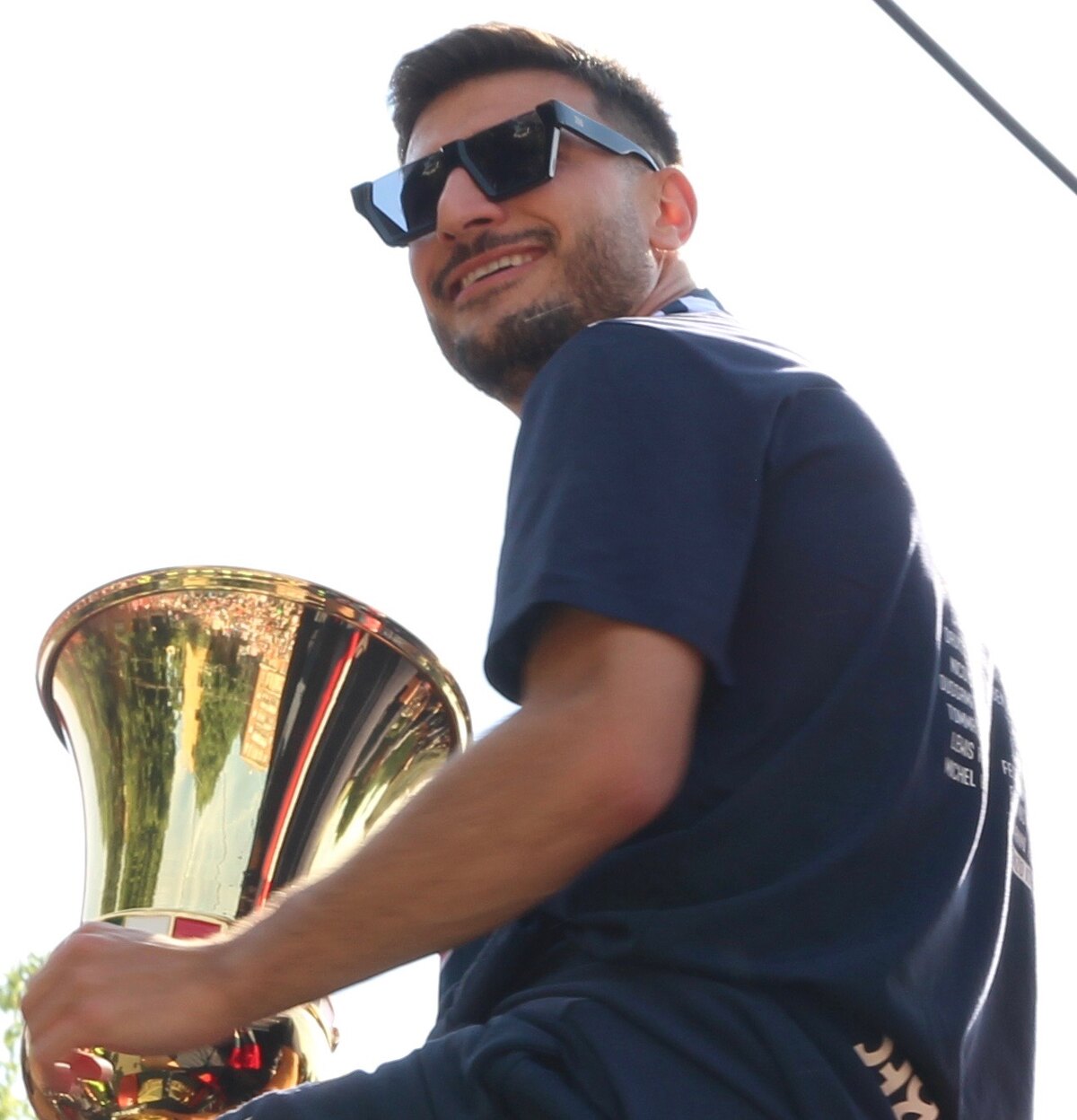
On 20 August 2026 Bologna announced the extension of Riccardo Orsolini’s contract until 30 June 2031. It is the kind of news you read in ten seconds and file under club business, when it is first of all a tactical decision: it declares that for another five years the team’s attacking right flank will have the same shape.
The renewal at a glance
| Item | Detail |
|---|---|
| Player | Riccardo Orsolini |
| Born | 24 January 1997 (29) |
| Position | Right-sided attacking winger |
| Foot | Left |
| Height | 1.83 m |
| At Bologna since | January 2018 |
| Club numbers | 309 appearances, 87 goals, 33 assists |
| New expiry | 30 June 2031 |
| International | Italy, 13 caps |
What an inverted winger actually is
The definition is simple and the consequences are not. An inverted winger plays on the flank opposite his strong foot: Orsolini is left-footed and plays on the right, so every time he receives the ball his natural movement is not towards the touchline but towards the middle of the pitch.
Three knock-on effects follow.
The first concerns him: coming inside lets him shoot, and indeed his eighty-seven club goals do not come from a creator’s role but from a role that generates shots. The second concerns the right-back, who is obliged to push up and provide width, because if the winger tucks in the flank is left empty. The third concerns overall balance, because a full-back who pushes up is one defender fewer the moment the ball is lost.
Keeping an inverted winger, in other words, is not a decision about one player. It binds three positions and defines how the team defends while it attacks.
The half-space, and why it matters
The zone where an inverted winger really works is not the flank, it is the intermediate channel between the opposing full-back and centre-back, the one everyone has taken to calling the half-space.
It is an awkward area for defenders, because it does not clearly belong to anyone: the full-back who steps out exposes the space behind him, the centre-back who slides across opens the middle of the box. Occupying it permanently forces the opposing defence to decide every time who goes, and every decision taken in a hurry produces errors.
Much of Orsolini’s output is explained that way. He is not a dribbler who beats his man down the line, he is a player who receives between the lines, comes inside and produces a shot or a final pass. The 2024-25 season, closed with fifteen league goals, is the clearest picture of that way of playing.
The price of predictability
The structural flaw of this profile is that his intentions are known. Every defender facing Bologna knows the right winger will come back onto his left foot, and that information can be used: send the full-back to shut the inside, angle the body to force him down the line, double up with the central midfielder.
The paradox is that predictability does not cancel effectiveness, it turns it into a management problem. If the defence sets up to prevent the cut inside, it opens the flank, and at that point the overlapping full-back becomes the free man. The threat moves rather than disappearing.
That is why an inverted winger works better after years at the same club than in his first season there: the patterns with the full-back and the central midfielder are what makes an otherwise readable situation ambiguous, and those patterns are not bought, they accumulate.
Why renew at twenty-nine
The question that always follows a long contract for a player near thirty is whether it makes financial sense. It is worth turning around: what would it cost today to buy back what Bologna would have lost by letting him go?
It is not only about goals. A winger with 309 appearances at the same club is a library of shared solutions with his teammates, and the value of that library appears in no market valuation. A replacement always arrives with a hidden cost, paid in points across the first two seasons while he learns where everyone else moves.
The contract until 2031, with the player turning thirty-four at expiry, says the club has done that maths and chosen continuity. The salary figures circulating in the press, around 2.8 million net per season, are journalistic indications rather than official data, but even taken at face value they describe an investment well within scale for a club that has recently won a Coppa Italia and played in Europe.
What to watch from here
The 2026-27 Serie A season begins on the weekend of 21 to 23 August, and the first thing to observe is only apparently trivial: how much time Orsolini spends on the touchline and how much inside the pitch.
If the share moves inward, it means the team has chosen to give him more central ground and to hand width to somebody else permanently. If it stays where it is, the structure is confirmed. It is a detail visible to the naked eye, no advanced data needed, and it says more than any statement about the future.
Data and information gathered from public sources: Bologna FC 1909’s official statement of 20 August 2026, Italian sports media, public statistical and biographical archives. Salary figures are those reported by the press and should be read as indications.
Frequently asked questions
How long has Orsolini extended with Bologna?
Until 30 June 2031. The club announced the agreement on 20 August 2026: at expiry the player will be 34 and will have spent thirteen and a half years at the club.
What are his Bologna numbers?
309 appearances, 87 goals and 33 assists since January 2018, when he arrived from Juventus. His best scoring season was 2024-25, which he closed with fifteen league goals, the same year Bologna won the Coppa Italia.
What exactly is his position?
Right-sided attacking winger, left-footed, 1.83 metres tall. That is the inverted winger profile: he starts wide and comes inside to shoot or to play the final pass.
Why does an inverted winger change a team's structure?
Because he vacates the touchline while occupying the inside channel. That forces the full-back on his side to push up to provide width and shifts the team's defensive balance: it is a choice that conditions three players, not one.
Does a renewal at 29 make sense?
It makes sense if you look at what buying that output would cost today. A winger with eighty-seven Serie A goals and a full grasp of his team's patterns is not replaced by a modest signing: he is replaced by two or three seasons of adaptation.