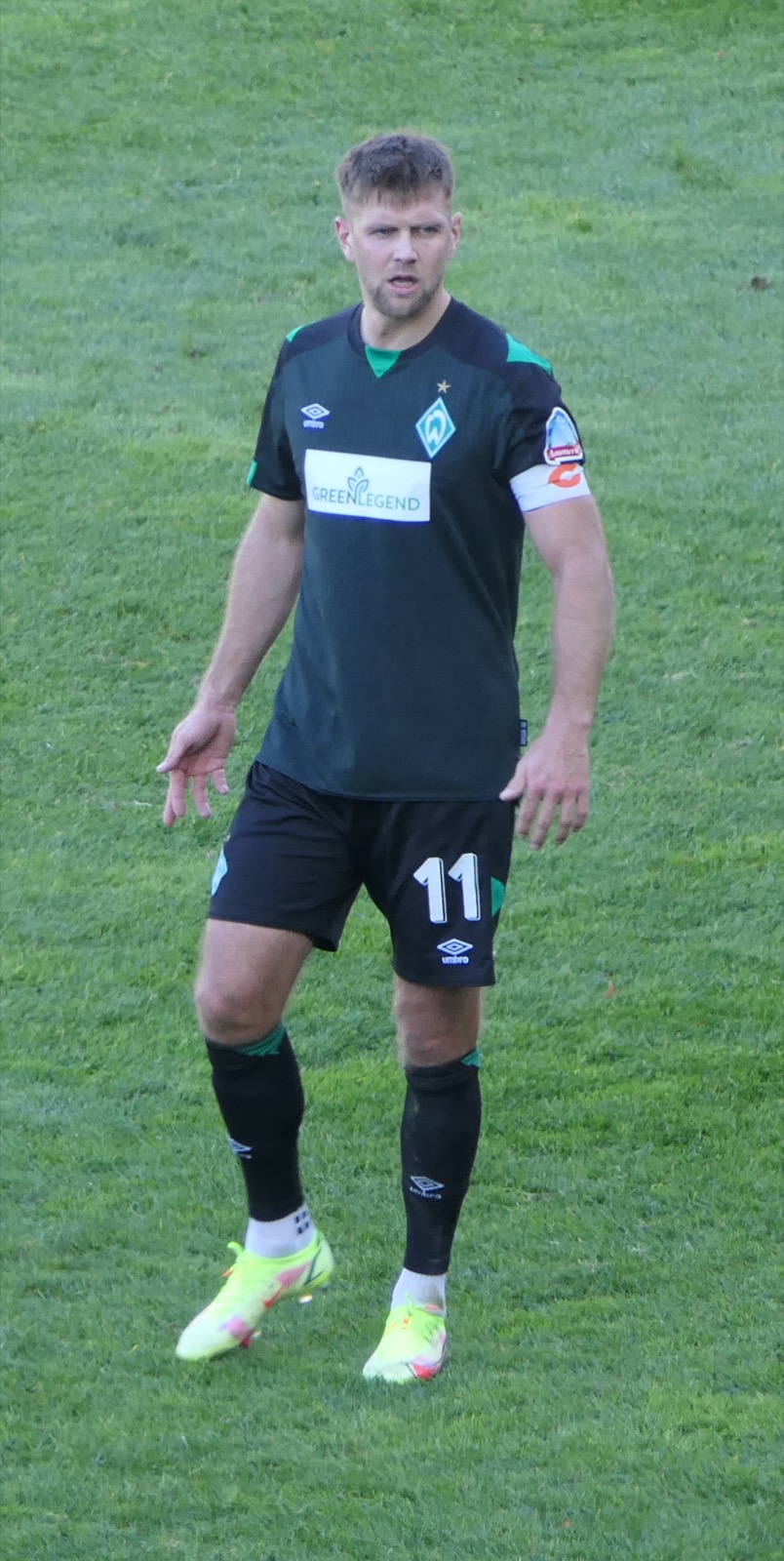
Niclas Füllkrug is back at Werder Bremen on a straight loan from West Ham, with no purchase option and a reduced wage. It is his third spell in green and white, at thirty-three and after two seasons with very few goals. The news reads in ten seconds, but behind it sits a tactical decision worth opening up: what a team actually buys when it signs a classic box striker.
The profile
| Item | Detail |
|---|---|
| Player | Niclas Füllkrug |
| Born | 9 February 1993 (33) |
| Place of birth | Hanover, Germany |
| Position | Centre-forward |
| Height | 1.89 m |
| Terms | Season-long loan from West Ham, no option |
| First two Werder spells | 49 goals in 124 competitive games |
| Bundesliga and second tier | 103 goals in 292 appearances |
| International | Germany, 24 caps and 14 goals |
What a box striker actually does
Werder head coach Daniel Thioune introduced him with four adjectives: physically strong, excellent in the air, technically sound, able to hold up the ball. Those are four distinct skills that modern football tends to flatten into a single word, and they are worth separating.
The first is the ability to receive with his back to goal, with a defender on him, and not lose the ball. That is what lets a team move up the pitch: if the striker holds it, the midfield gets three seconds to close the gap and the opposing defence cannot push forward.
The second is aerial play, which in the modern game matters above all at set pieces and on long clearances. A team that defends deep and has to clear its box needs someone who keeps that ball in play rather than handing it straight back.
The third is finishing inside the six-yard box, the hardest of the three to measure because it depends almost entirely on the balls that arrive.
Why the profile fell out of fashion
For fifteen years or so the box striker was described as a leftover. Dominant teams asked their number nine to leave the box, play between the lines and take part in the build-up. A player who could only attack the space and head the ball looked incomplete.
The return of that profile is not nostalgia. It follows from two very concrete things. First, defences have dropped and compacted, and against a closed block a through ball is worth less than a cross. Second, set pieces have become one of the few sources of goals that organisation alone cannot defend: a side with a six-foot-two man attacking the near post holds a structural advantage.
The problem of the last two seasons
Here comes the uncomfortable part. Over the last two campaigns Füllkrug has scored very little: 3 goals in 26 games for West Ham and one goal in 20 appearances on loan at Milan in the second half of 2025-26.
Age alone does not explain that. Of all positions, the box striker is the one most dependent on context. He does not create his own chances: he receives them. If the team does not produce crosses, does not play the back post and does not attack the box with four bodies, that player can do everything else well and still finish the season on three goals.
That is exactly why his best numbers came at Werder, 49 goals in 124 games across his first two spells, and in the season he finished as Bundesliga top scorer in 2022-23.
What Werder must do to make it work
The move only makes sense if it comes with a coherent way of playing. It needs wingers who cross rather than always cutting inside on the opposite foot, a midfielder attacking the back post, and a willingness to accept that some of the goals will come from situations advanced metrics rate poorly.
There is also an element that belongs to the accounts rather than the pitch: a one-year loan, no option, no reported loan fee and a wage cut accepted by the player. Werder get a season of an experienced striker without committing. If it works, a season is solved. If it does not, in June the player goes back to London.
The point
Signing a classic nine is not a conservative choice, but it is not a neutral one either: it obliges the team to build in a certain way. Werder start on 30 August away at Freiburg, and the opening weeks will show whether a way of attacking has been built around Füllkrug or whether he has simply been handed a shirt with symbolic weight.
Sources: official Werder Bremen and West Ham United communications, the official Bundesliga portal, German sports press, public statistical archives.
Frequently asked questions
On what terms has Füllkrug returned to Werder Bremen?
A one-season loan from West Ham United with no purchase option. According to the German press there is no loan fee and the player accepted a wage reduction to make the move possible.
How many spells has he had at Werder Bremen?
This is his third. Across the first two he scored 49 goals in 124 competitive appearances, making his first-team debut in January 2012 at eighteen and helping the club win promotion in 2022.
What kind of striker is he?
A classic box striker. Head coach Daniel Thioune described him as physically strong, excellent in the air, technically sound and able to hold up the ball. That is the profile usually called a reference point.
Why were his last two seasons disappointing?
He scored 3 goals in 26 games for West Ham and one goal in 20 appearances on loan at Milan in the second half of 2025-26. A striker of this type depends on the kind of supply he receives more than on his own form.
How many goals has he scored for Germany?
14 goals in 24 caps, with appearances at the 2022 World Cup and Euro 2024.