In the World Cup final on 19 July, Spain had 65 per cent of possession and 83.3 per cent of the field tilt. Two numbers describing the same match and telling two different stories, and the distance between them is precisely the point. The second one is worth understanding, because it is one of the few advanced metrics you can rebuild by hand.
How it is calculated
Field tilt is the share of final-third passes a team takes relative to the total produced by both sides together. Nothing more. You count completed passes in the zone in front of the opponent’s goal, add up both teams’ totals, and see who holds the bigger slice.
In the final Spain completed 235 passes in the final third, Argentina 47. The sum is 282. Two hundred and thirty-five divided by two hundred and eighty-two gives 0.8333: that is where 83.3 per cent comes from. No black box, no model: it is a division.
The numbers from the final
| Item | Spain | Argentina |
|---|---|---|
| Possession | 65% | 35% |
| Passes in the final third | 235 | 47 |
| Field tilt | 83.3% | 16.7% |
| Shots | 20 | 2 |
| Shots on target | 12 | 0 |
| Expected goals (xG) | 2.34 | 0.38 |
Possession separates the two sides by thirty percentage points. Field tilt separates them by sixty-six. It is the same match read twice, and the second reading is far harsher on Argentina than the first.
Why the two numbers diverge
Possession counts every ball played, wherever it happens. It includes the pass between two centre-backs, the ball rolled back to the goalkeeper, the slow build twenty metres from your own goal. It is a measure of time, not of position.
Field tilt ignores everything that happens before the final third. If a team circulates the ball at the back for seventy minutes and never enters the zone that matters, possession flatters it and field tilt exposes it. The reverse case exists too: a side that wins the ball high, strings ten passes together near the box and then loses it will build field tilt without building possession.
In the final the divergence has a simple explanation. Argentina set up in a low block and defended, leaving their own half very rarely. When they regained the ball they played it backwards or lost it: 47 final-third passes in a hundred and twenty minutes is the portrait of a team that almost never arrived where it needed to arrive.
How Spain built that number
The published analyses describe Spain with a 4-2-3-1 base and Argentina with a very compact, very deep 4-4-2. But the starting shape matters less than the way the Spanish occupied space once they had the ball.
The two key movements are opposite and simultaneous. The centre-forward dropped off, pulling out of the Argentine centre-backs’ line, while one of the two holding midfielders pushed up into the space he had left, between the lines. The left-back held the width, which freed the winger on that side to come inside. The practical outcome was a three against two in midfield, which is the number you need to move the ball forward without risking it.
Argentina held for a very long stretch, managing the height of their line and stepping out onto the spare central player when required. Then the block deteriorated for a reason no metric anticipates: injuries to both centre-backs removed structure from the part of the team that was holding the structure together.
The moment territory turned into a goal
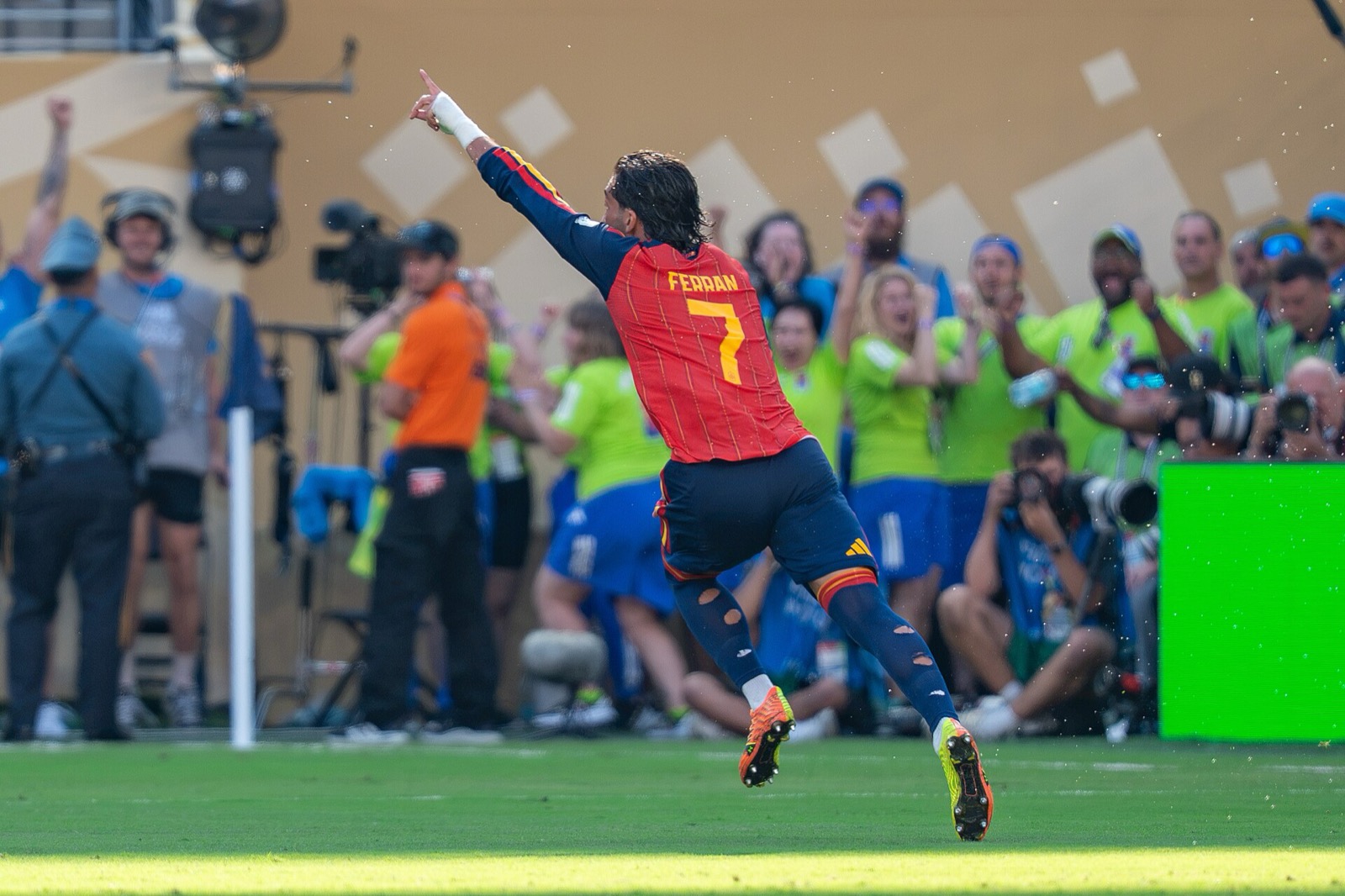
It took 106 minutes. Enzo Fernández had been sent off for a second booking late in normal time, so Argentina were defending with ten. From Pedro Porròs cross, Nico Williams headed the ball down and Ferran Torres arrived in the space the ball-side midfielder had failed to protect.
That detail is worth more than the whole table. Territorial dominance of 83.3 per cent produced a single goal, in extra time, against ten men. Argentina, for their part, committed 25 fouls, their highest total in a final since 2022, when they committed 26 against France.
What field tilt does not tell you
The limit is in the definition. The metric records where the ball was played, not how dangerous it was to play it there. Thirty sideways passes at the edge of the box against a closed block count, for field tilt, exactly as much as thirty passes that dismantle a defence.
Then there is a whole category of teams for which a low field tilt is not a problem: the ones that concede territory deliberately and live on transitions. If the plan is to defend inside twenty-five metres and run into the space behind, a low number does not certify a tactical defeat, it certifies that the plan worked. Reading this metric without the strategic context means reading it badly.
In the case of the final the context does hold up: 20 shots to 2 and 12 efforts on target against zero say the territory converted into danger as well. That difference of 18 shots is the second widest ever recorded in a World Cup final, behind only West Germany’s 23 shots to 1 in 1990.
The picture across a whole tournament
The field tilt in the final is not the anomaly of one evening. Across eight matches Spain conceded a single goal, Charles De Ketelaere’s for Belgium, and allowed opponents 2.3 expected goals in the entire tournament: an average of 0.3 per game, the lowest figure ever recorded at a men’s World Cup. They never trailed in any of the eight games, and their unbeaten run reached 38 matches.
Spain’s second world title, after 2010, therefore comes from a team that built its advantage where football is least visible: not in the number of goals, but in the number of metres it forced everyone else to play in.
Sources: tactical analyses and statistical datasets published on the 2026 World Cup final, international news agency reports and public tournament archives. Expected goals figures come from the models published on the match.
Frequently asked questions
What is field tilt in football?
It is the share of final-third passes a team takes relative to the combined total of both sides. You divide a team's completed passes in the final third by the sum of both teams' final-third passes. It measures where the ball was played, not how long it was held.
What is the difference between possession and field tilt?
Possession counts time or total passes wherever they happen, including the ball being circulated among defenders. Field tilt only counts the zone in front of the opponent's goal. A team can have plenty of possession and very little territory: that happens when the ball goes sideways at the back and never enters the half that matters.
What was the field tilt in the 2026 World Cup final?
83.3 per cent for Spain. It comes from 235 completed passes in the final third against Argentina's 47: 235 divided by 282 is exactly 0.833.
Does a very high field tilt guarantee a win?
No. It tells you where the game was played, not how dangerous the chances were. In that final Spain dominated territory and still needed 106 minutes and an opponent down to ten men to score the only goal.
Which teams win with a low field tilt?
Sides built on a low block and transitions, which give up territory on purpose in order to strike in open space. For them a low number is not a symptom of inferiority: it is the game plan.