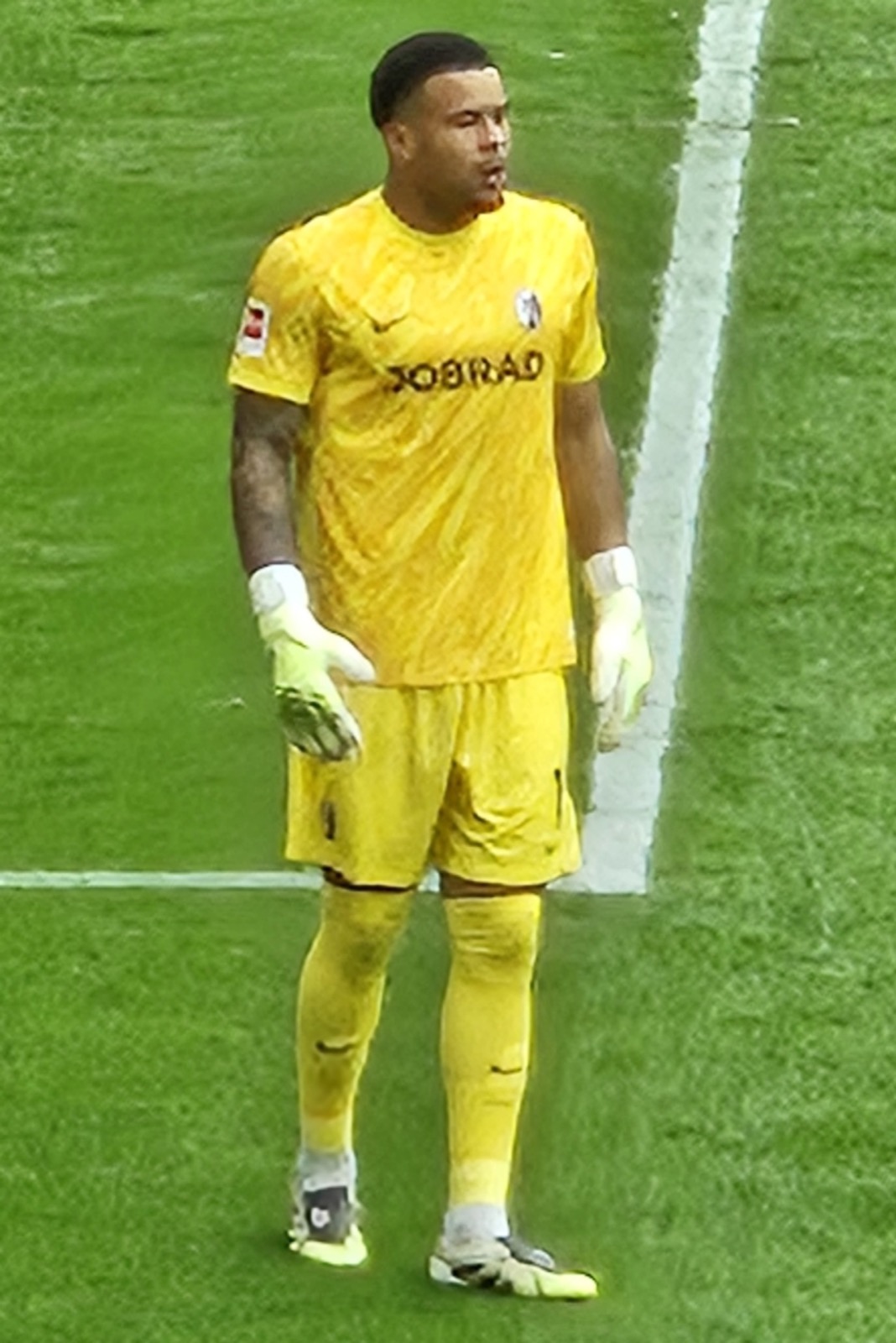
On 28 August 2026 SC Freiburg and Eintracht Frankfurt announced the same piece of business, and the headline on the Freiburg statement sums it up in a single line: Noah Atubolu extends his contract and goes to Frankfurt on loan. The two things look like opposites, and instead they are one thing in two stages. The renewal is not the gesture of a player who is staying: it is the instrument that allows him to go.
The deal in brief
| Item | Detail |
|---|---|
| Player | Noah Atubolu, goalkeeper |
| Born | 25 May 2002 in Freiburg im Breisgau (24 years old) |
| Height | 1.90 m |
| From | SC Freiburg |
| To | Eintracht Frankfurt |
| Structure | Loan until the end of the 2026/27 season |
| Buy clause | Option that becomes an obligation on conditions not made public |
| Precondition | Renewal at Freiburg, new expiry date undisclosed |
| Figures | None published by the clubs |
| Shirt | Number 1, as at Freiburg |
The renewal as a key, not as a promise
Atubolu’s contract with Freiburg ran out on 30 June 2027: at the start of the 2026/27 season only a single year was left, and a single year is the threshold that blocks everything, because a professional with such a short spell remaining cannot be sent out on loan. As long as that date stayed where it was, Freiburg had two roads and neither of them was good: keep him for twelve months as a back-up goalkeeper and lose him on a free, or sell him permanently with the buyer reading the expiry date and negotiating accordingly.
The renewal opens up a third. By pushing the deadline back, the player becomes loanable again, and the loan becomes the frame into which the fee, the buy clause and the conditions can be slotted. It is worth separating, though, what the clubs have written from what they have not: the renewal is official and sits in the headline of the Freiburg statement, the new expiry date is not, and the 2028 doing the rounds comes from kicker. Nor does the rule that makes a player in the final year of his deal ineligible for a loan appear in the statements: the official documents contain the sequence, not the regulation that imposes it.
The one admission of the tug of war
Jochen Saier, Freiburg’s Sportvorstand, that is, the member of the executive board with responsibility for sport, said the line that weighs more than all the rest: “we have been through some very complicated weeks and months. The contract extension came out of very open and constructive discussions and gave us the flexibility to find a solution”.
Flexibility is exactly the right word. It is not the language of loyalty, it is the language of how a deal is structured, and it says that the renewal was negotiated to make the exit possible, not to prevent it. Markus Krösche, Eintracht’s sporting director, stays on the player instead: “in Noah we are adding a strong, ambitious goalkeeper who is already very experienced”. One club explains the mechanics, the other presents the signing.
Option, obligation, and two sets of figures that do not add up
Here a piece of precision is needed. Eintracht’s German statement does not speak of a straight obligation to buy: it speaks of a purchase option that converts into an obligation once certain conditions are met. Freiburg uses an even broader formula, saying that the transfer becomes permanent if certain conditions are satisfied. What those conditions are, neither of them has written down.
The difference is not a formality: an option leaves the risk with the club lending the player, an obligation shifts it onto the club taking him, and the conversion between the two is the point where the clubs met. On the value the documents are no help, because neither company has published an amount, not for the fee, not for the buy clause, not for the bonuses. The German press is circulating two reconstructions that do not tally: according to kicker a fee of one million and a buy clause of 12.5 million, rising to around 16 million with the bonuses, according to Sky Sport Germany an obligation worth 13 million. They are not two pieces of the same sum: one million plus 12.5 makes 13.5, not 13. They are two different readings of the same deal.
What changes for the two goalkeeping departments
The sporting layer comes afterwards, but it is not the lesser one. Atubolu arrives off a full season as first choice: all 34 Bundesliga matchdays in 2025/26 and all 15 games of a European run that ended with the final lost 0-3 to Aston Villa on 20 May, thirteen goals conceded in fifteen matches. Before that he had set two records: 609 consecutive minutes without conceding, an SC Freiburg record, and five penalties saved in a row, a Bundesliga record. The statements count 125 official games with the first team, plus 81 with the second.
At Freiburg his goal had already been handed to someone else before he left, because the club had signed Mio Backhaus from Werder Bremen and named him the new number one: the exit was planned, not endured. At Frankfurt, by contrast, he walks into a crowded department, and on the official squad page he is listed with the number 1 ahead of Michael Zetterer, Jens Grahl, Amil Siljevic and Kaua Santos. For a goalkeeper that number matters more than it does elsewhere: the pecking order in the position is binary, you either play or you do not, and there are no twenty minutes a game in which to show yourself.
What to watch now
The German window closes on 1 September and the visible part of the deal is already written. The invisible part sits in the conditions that convert the option into an obligation: since they are not public, every theory about what sets them off remains a theory. The only indicator readable from the outside is the pitch: how many games Atubolu plays, and from what point in the season, will say more about where this deal ends up than any figure reported today. And it will also say whether Freiburg, in letting go of a goalkeeper born and raised in the city, picked the right moment.
Sources: official statements from SC Freiburg and Eintracht Frankfurt of 28 August 2026, the German league website, Eintracht’s official squad page, encyclopaedia entries and the German press. The figures have not been confirmed by the clubs and should be read as press speculation, as should the new expiry date of the contract at Freiburg.
Frequently asked questions
What kind of deal is Atubolu's move to Eintracht Frankfurt?
A loan until the end of the 2026/27 season. Eintracht's German statement speaks of an option to buy that turns into an obligation once certain conditions are met, none of which either club has made public.
Why did Atubolu renew with Freiburg if he then left straight away?
Because the renewal was the condition for the loan: a professional with only one year left on his contract cannot be sent out on loan, and the old deal ran out on 30 June 2027. Freiburg's statement does indeed put the two things in the same headline.
How much is the deal worth?
Neither club has published any figures. According to kicker it would involve a loan fee of one million euros and a buy clause of 12.5 million, rising to around 16 million counting the bonuses, while Sky Sport Germany speaks of 13 million. These are press reconstructions that do not match one another.
Has Atubolu played for the senior national team?
No, he has never made his debut for the senior Germany side: he received a call-up in October 2025 without taking the field. At Under 21 level he has 22 caps, a record for a goalkeeper in that age group.
Who is in goal for Freiburg now?
The club had already signed Mio Backhaus from Werder Bremen during the summer, identifying him as the new number one. Atubolu's departure was therefore planned in advance rather than improvised.