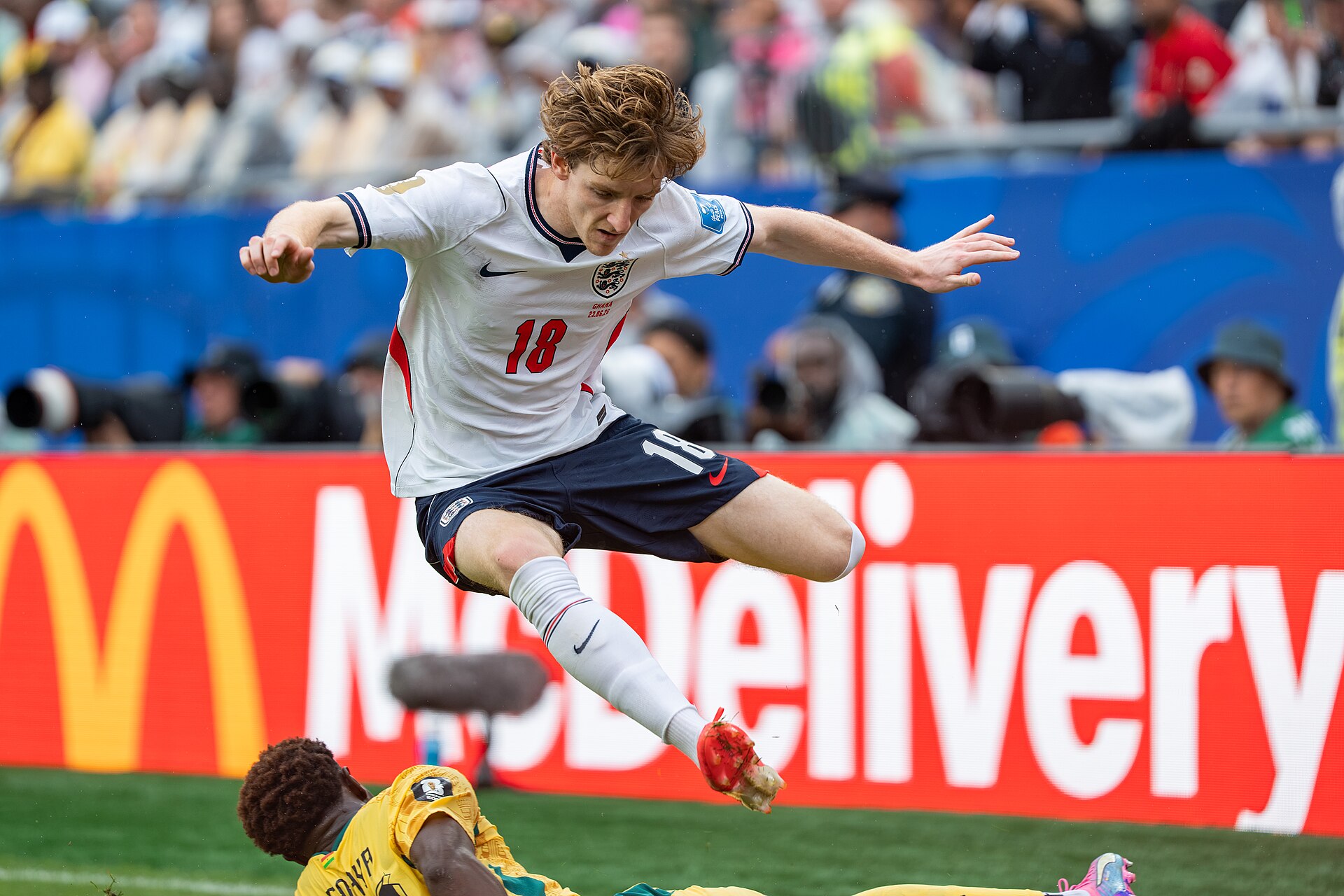
Anthony Gordon is a Barcelona player: the English winger arrives from Newcastle United for a fee close to 70 million euros (rising above 80 with add-ons) to strengthen Hansi Flick’s attack. He is not the centre-forward brought in to replace Robert Lewandowski, but a right-footed wide man who widens the range of options in the final third: in the Catalan 4-3-3 he can act as a left winger mirroring Lamine Yamal and, when required, drop into a false nine. In this analysis we look at where he will really play, who he challenges, and which mechanisms he amplifies.
The deal at a glance
Barcelona officially announced Gordon on 29 May 2026 on a five-year deal. These are the verified details of the move:
| Item | Detail |
|---|---|
| Player | Anthony Gordon (25, England international) |
| Role | Left winger, right-footed, adaptable through the middle |
| From | Newcastle United |
| To | FC Barcelona |
| Fee | around 70 million euros base, over 80 with add-ons (69.3 million pounds) |
| Contract | five years |
| Head coach | Hansi Flick |
| System | 4-3-3 that reads as a 4-2-3-1 |
The deal sits inside a wider attacking overhaul: Lewandowski left the club as a free agent, freeing space and a significant chunk of the wage bill, and Barcelona remain in the market for a genuine number nine (Julián Álvarez among the names linked). Gordon, then, does not plug the striker gap: he adds legs, goals and pressing to a front three already among the best in Europe.
Who is Anthony Gordon
Technical traits and natural role
Gordon is a modern left winger: right-footed, he plays down the left flank as an inverted wide man, meaning he cuts inside onto his stronger foot to shoot or thread the final pass. His trademark is running: depth, bursts in one-on-one duels, attacking the space behind the defence. To that he adds aggressive, relentless pressing, a trait that has made him a valuable piece in the recovery phase.
Recent form
In the 2025/26 season Gordon was Newcastle’s top scorer with 17 goals across all competitions. The figure that matters most is the European one: 10 goals in the Champions League, a tally beaten only by Kylian Mbappé and Harry Kane that season, with the Magpies reaching the last 16. Six of his goals came in the Premier League. Numbers that confirm a player in his prime, able to make a difference on the biggest stage.
Strengths and limits
The strengths are clear: raw pace, attacking depth, intensity in the press, composure in transition. The limit, if anything, is one of context. At Newcastle Gordon shone in a team that concedes ground and counters; at Barcelona he will have to hurt set defences and low blocks too, with little space ahead of him and the ball always at his feet. It is the most delicate adaptation challenge of his transfer.
Flick’s Barcelona system
Hansi Flick has rebuilt Barcelona around a precise idea: high possession, verticality and courage without the ball. The team builds up in a 4-3-3 that in the attacking phase often slides into a 4-2-3-1, with a double pivot and an attacking midfielder shaping the central geometry. In 2024/25 average possession was close to 69% and the side scored more than 100 league goals: the blueprint is vertical tiki-taka, quick combinations always looking for the forward pass.
Out of possession, Flick’s Barcelona is among the bravest teams in Europe: a very high defensive line, a systematic offside trap and immediate counter-pressing on the ball carrier. It is a system that compresses the pitch and forces the opponent into mistakes, but that leaves space in behind the centre-backs. It therefore needs quality width on the flanks and legs to cover that depth.
The front three revolves around two left-footers: Lamine Yamal, an inverted right winger (24 goals and 17 assists in 2025/26), and Raphinha, also left-footed, deployed mostly on the left. Through the middle, until June, sat the sheer weight of Lewandowski.
How Gordon fits in: the tactical analysis
This is the tactical crux. Gordon is a left winger and the left flank, today, belongs to Raphinha. The first consequence is direct competition and a high-level rotation on the left, where Flick can alternate two opposite profiles: Raphinha, more combinative and creative, and Gordon, more vertical and devastating in open space. Against low blocks the Brazilian may be preferred; against teams that stretch out, or during a game to strike in transition, Gordon becomes a natural weapon.
But there is a symmetry that makes the signing smart. Being right-footed, Gordon on the left is an inverted winger who comes back onto his strong foot towards goal. On the opposite side Yamal, left-footed, does the same from the right. An attacking front with Gordon on the left and Yamal on the right means two wingers converging into the middle on their respective strong feet, multiplying finishes from the heart of the box and freeing the flanks for the full-backs to overlap. It is exactly the kind of verticality Flick is after.
The second key is the central option. Gordon can play as a false nine or a second striker, and with Lewandowski gone and the first-choice centre-forward still to be bought, he offers Flick a hybrid solution in the short term: an attack with no fixed reference point, where the English winger attacks the space behind the opposing defence while Yamal and Raphinha tuck in. It is not his ideal long-term position, but it is a valuable card in the opening rounds.
Defensively, finally, Gordon is a perfect fit. His incessant pressing feeds Flick’s counter-press, and his pace is an insurance policy against the risk of the very high line: he is the type of winger who chases and recovers, covering the depth when the offside trap does not spring.
Possible frictions? Two. Managing spaces against closed defences, where Gordon’s transition qualities count for less, and the role overlap with Raphinha, which will force Flick into careful choices and rotation to keep both involved and content.
What changes for Barcelona
Barcelona gain squad depth and unpredictability. Previously the front three depended enormously on Yamal and Raphinha: with Gordon, Flick has a third top-level option on the flanks, legs for transitions and a central plan B while waiting for the new nine. Across a long season between the Liga and the Champions League, this qualitative width matters in managing energy. The striker question stays open: until he arrives, the balance of the attack will also rest on Gordon’s ability to reinvent himself through the middle.
Verdict
Gordon at Barcelona is a signing of substance rather than spectacle. It does not solve the number-nine issue, but it raises the level and variety of Flick’s attack, adding a profile (pace, depth, pressing) the front three lacked. His tactical fate hinges on the left flank in a relay with Raphinha and on his ability to adapt to a game of possession and tight spaces, far from the open pastures of Newcastle. If he makes that leap, Barcelona will have found not a mere squad filler, but a multiplier of options for Yamal and company.
Frequently asked questions
Where will Anthony Gordon play at Barcelona?
As a left winger in Hansi Flick's 4-3-3, alternating and rotating with Raphinha. Being right-footed, he acts as an inverted winger who cuts inside. When needed he can be used as a false nine.
How much did Gordon cost Barcelona?
Around 70 million euros as a base fee, rising above 80 million with add-ons (69.3 million pounds). He signed a five-year contract, officially confirmed on 29 May 2026.
Does Gordon replace Lewandowski?
No. He is not the centre-forward's replacement: Lewandowski left Barcelona at the end of his contract and the club is still chasing an out-and-out nine. Gordon is a reinforcement for the front line, not a first-choice striker.
In which formation does Gordon fit?
In Flick's 4-3-3, which in possession reads as a 4-2-3-1. His profile amplifies the verticality and high pressing typical of the Catalan system.
What kind of player is Anthony Gordon?
A fast, direct left winger, right-footed, strong at attacking depth and at pressing. In 2025/26 he scored 17 goals for Newcastle, including 10 in the Champions League.