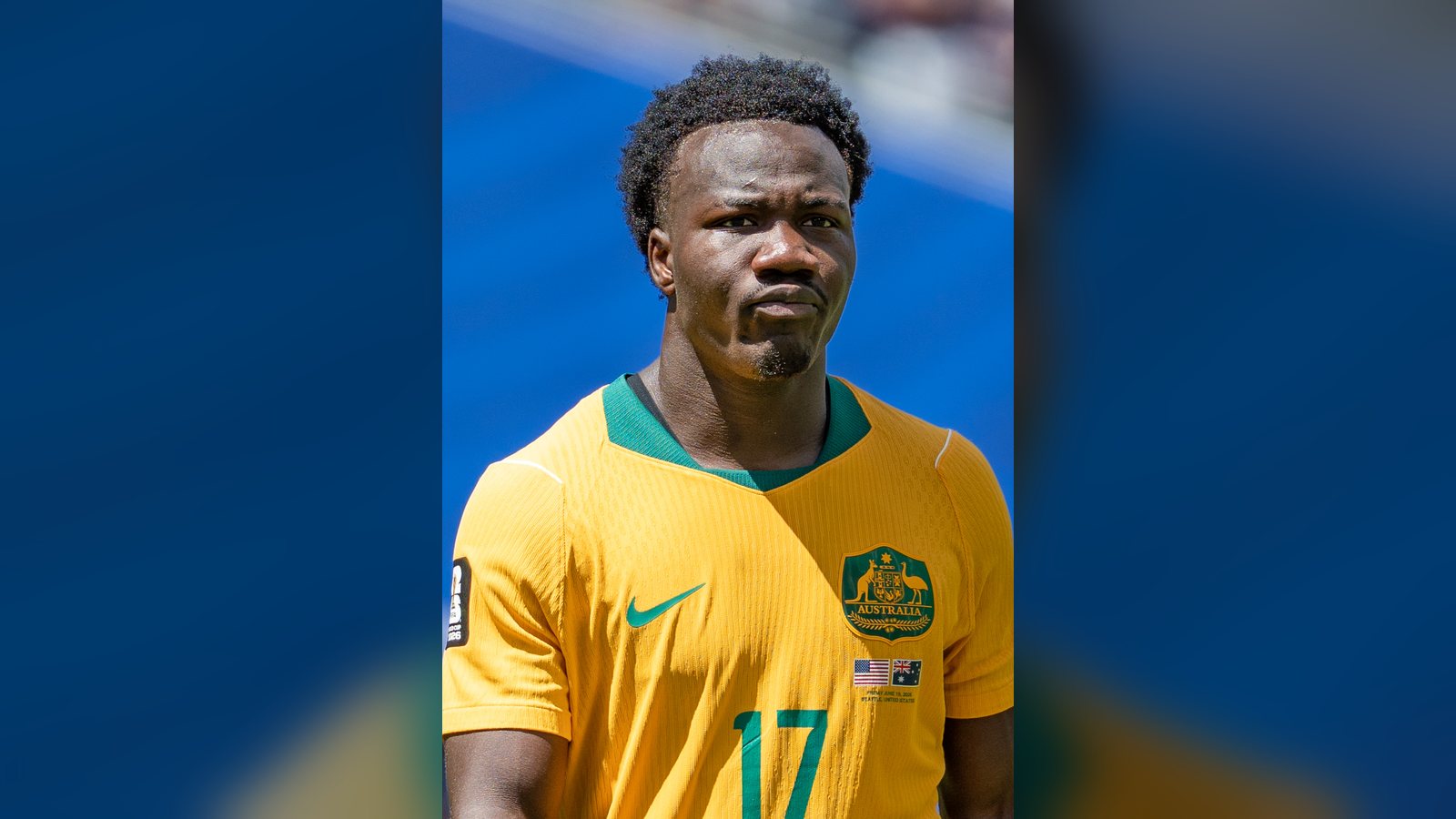
Nestory Irankunda is twenty years old and has already changed clubs four times in two seasons: Adelaide, Munich, Zurich, Watford. The fifth is Sporting CP, who announced him on 15 August with a contract to 2031. Portuguese reporting describes fifteen million euros plus three in add-ons to Watford, and a release clause set at eighty. Those are reported figures, not club statements.
The profile at a glance
| Item | Detail |
|---|---|
| Player | Nestory Irankunda |
| Born | 9 February 2006 (20) |
| Birthplace | Kigoma, Tanzania |
| International | Australia |
| Position | Wide forward |
| Height | Around 1.75 m (sources vary between 1.74 and 1.76) |
| Foot | Right |
| Club | Sporting CP (since 15 August 2026) |
| Contract | Five years, to 2031 |
| Caps | Australia (19 appearances, 6 goals) |
From a refugee camp to Adelaide
The biography matters here, because it explains the character of a career that has moved fast.
Irankunda was born in Kigoma, Tanzania, the third of eight children in a Burundian family that fled the civil war. He was three months old when the family reached Western Australia, seven when they moved to the northern suburbs of Adelaide. He started playing at eight for a local club, and his older brothers stopped playing to cover his fees.
He joined Adelaide United in 2021 and made 60 league appearances with 16 goals for the first team. In 2023-24 he was named joint A-League Young Footballer of the Year with Alex Paulsen, and in October 2023 the Guardian listed him among the sixty best young players in the world: the only Australian on the list.
The three European stops
In July 2024 Bayern Munich signed him for a record A-League transfer fee, reported at around four million. It did not work: one season with the reserve side, fifteen appearances and four goals, no first-team minutes, then a loan at Grasshopper with nineteen appearances and one goal.
In July 2025 came Watford, on a five-year contract. Forty league appearances and four goals in the Championship, the first of them a twenty-five-yard free kick at Swansea in August 2025.
That path is worth reading carefully, because it describes a specific risk: moving at eighteen to a club with no room for him burned a season of development that matters more at that age than it does later.
What he does on the pitch
The technical profile is that of a winger who lives on one against one. Pace, dribbling, the ability to stretch a back line and then come inside to build a shot or a cross. At Adelaide he mostly played on the right and attacked the inside of the pitch.
Two traits separate him from the standard profile. The first is shooting power: inside the box he tends to finish rather than look for a teammate, and from distance he has a strike that changes games. The second is his ability to draw fouls, an underrated skill precisely because it rarely appears in public statistics while it moves a team’s average position up the pitch.
In his breakthrough season at Adelaide his game became less individual: more lay-offs for the forwards, more rotation between the two flanks and the central position inside a 4-3-3.
The detail that makes the move interesting
Sporting are said to have identified him as a reinforcement for the left side of the attack. If that is right, it is the most sensible choice available for a right-footer: on the left wing, cutting inside finishes on the stronger foot, and the whole repertoire he built on the right at Adelaide changes sign without changing substance.
Then there is the league. Liga Portugal has for years been the place in Europe where young attackers actually play and everybody watches. For a twenty-year-old who needs real minutes after two inconclusive seasons, it is a better environment than a mid-table side in a richer competition would have offered.
The real question
It is not about talent, documented since he was seventeen. It is about continuity.
Four clubs in two seasons means learning a new system four times, and for a wide player the system decides almost everything: whether you receive facing the goal or with your back to it, whether the full-back overlaps or stays, whether you are asked to track back or hold your height. Irankunda is twenty with a five-year contract, and for the first time since 2024 he has the chance to build something across consecutive seasons in the same place.
That is probably what he needs most, and the one thing no transfer fee can buy him.
Data and information gathered from public sources: Wikipedia, official club announcements, Portuguese and Australian press, statistical portals. Financial valuations are transfer market reports.
Frequently asked questions
Who is Nestory Irankunda?
An Australian winger born on 9 February 2006 in Kigoma, Tanzania, to Burundian refugee parents. He grew up in Adelaide, broke through at Adelaide United and since 15 August 2026 plays for Sporting CP.
How much did Sporting pay for Irankunda?
The clubs did not publish the fee. Portuguese reporting describes 15 million euros plus 3 million in add-ons to Watford, with a release clause said to be set at 80 million. Read those as reports.
What kind of winger is Irankunda?
A right-footed wide forward of around 1.75 m who uses pace and dribbling to stretch the field and then cut inside. He is known for the power of his shooting and for his ability to draw fouls.
Why did he leave Bayern Munich without playing for them?
He joined in July 2024 for a record A-League transfer fee, spent a season with the reserve side and then went on loan to Grasshopper. In July 2025 he moved to Watford in the Championship.
Has he played for Australia?
Yes. He has 19 caps and 6 goals for the senior side, after scoring 11 goals in 7 games at Under 17 level.