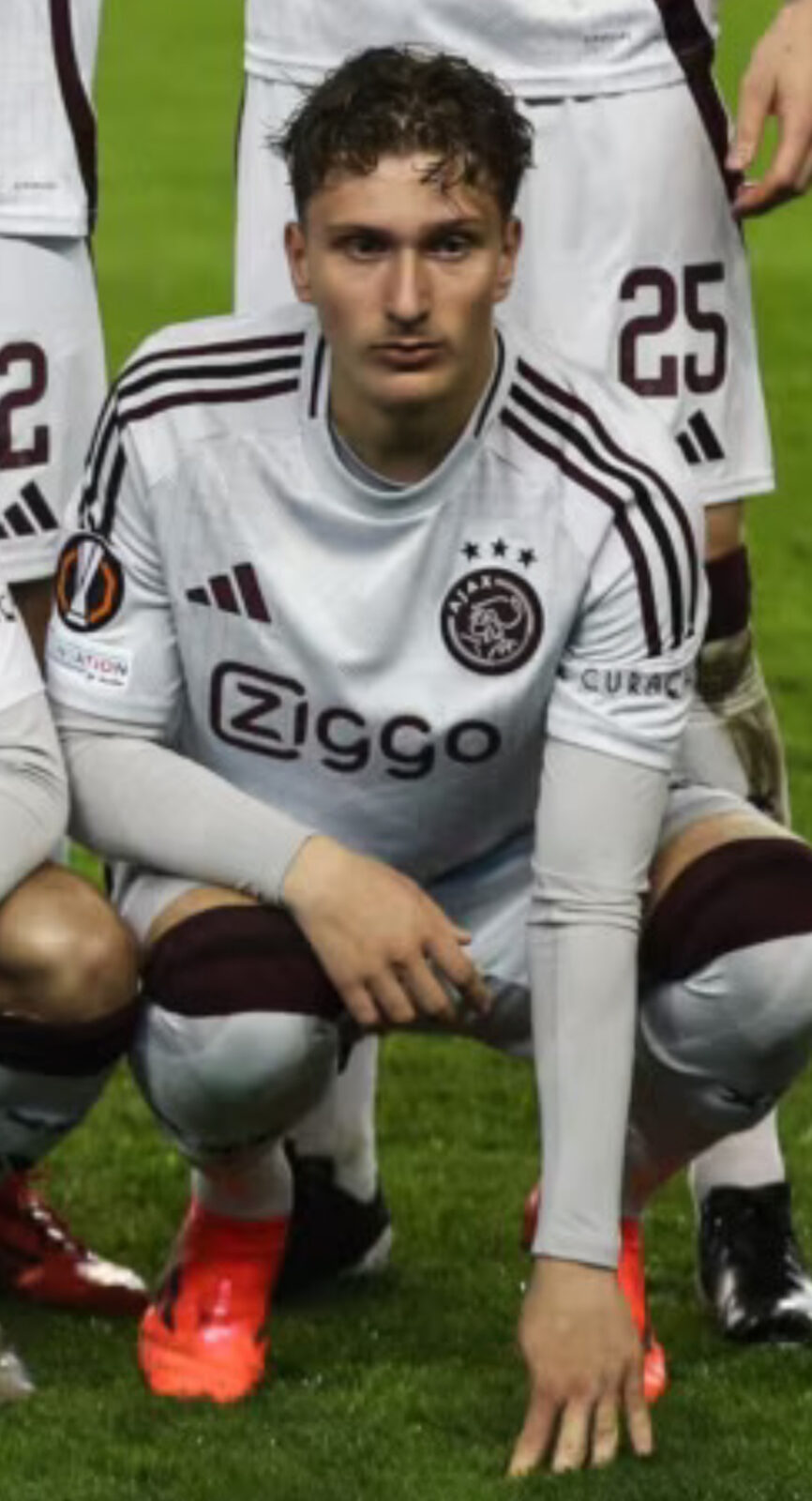
Mika Godts is twenty-one, scored 17 Eredivisie goals from the left wing and on 15 August moved from Ajax to Paris Saint-Germain on a five-year contract. International sources report a deal worth around 55 million euros including add-ons. In the same year he was voted the best young player of the Dutch season, Belgium left him out of the World Cup squad. Put together, those two facts describe exactly where he stands.
The profile at a glance
| Item | Detail |
|---|---|
| Player | Mika Godts |
| Born | 7 June 2005 in Leuven, Belgium (21) |
| Position | Left winger |
| Height | 1.76 m |
| Foot | Right |
| Club | Paris Saint-Germain (since 15 August 2026) |
| Eredivisie 2025-26 | 32 appearances, 17 goals |
| Season 2025-26 total | 44 appearances in all competitions |
| International | Belgium, 2 caps (debut 28 March 2026) |
The path
Godts came through Anderlecht’s academy until 2020, then moved to Genk, where he stayed three years. In January 2023 Ajax took him for a fee reported at around one million euros, with a sell-on percentage for the Belgian club. It is the kind of deal Dutch clubs have been doing for decades and which, three and a half years later, produces a capital gain worth almost fifty times the outlay.
In Amsterdam the growth was not immediate. The jump came in 2025-26, when he put together 32 appearances and 17 league goals and won the Johan Cruyff Award as the Eredivisie’s talent of the year, after being named best young player of the month on three separate occasions: November 2025, February 2026 and April 2026.
With Belgium’s youth sides he completed the whole ladder: one cap at Under 15, eight with a goal at Under 17, seven with two goals at Under 19. His senior debut came on 28 March 2026, and his caps stand at two.
What he does on the pitch
Godts is a left winger who kicks with his right foot. That is the inverted configuration, the one that occupies most attacking flanks in Europe today, and it serves a precise purpose: it lets the wide man cut inside with the ball on his stronger foot, either to shoot or to play the diagonal final pass.
His recognised trait is the one against one. He is a player who seeks the duel rather than avoiding it, who takes on the full-back instead of playing backwards. In modern football that is a quality bought at a high price, because it is the only way to break down a settled defence that concedes no space in behind.
What was new last season was not the dribbling, which he already had: it was the seventeen goals. A wide player who moves from beating his man to finishing changes category, because he stops producing situations for others and starts closing them himself. That is precisely the jump that justifies the fee.
His height of one metre seventy-six says the rest: he is a player of acceleration and change of direction, not of physical duels. Against a well-built centre-back waiting for him in the box he will always be at a disadvantage, and his ground is the flank, not central depth.
The number to read carefully
There is one element in his profile worth lining up with the rest. In the same season he was voted the Eredivisie’s talent of the year, he did not make Belgium’s World Cup squad. That is not a contradiction: it is the distance between dominating a league of average defensive density and holding a place in a national team that had other options for that tournament.
Seventeen Eredivisie goals are not seventeen Ligue 1 goals, and nobody assessing a player seriously treats them as equivalent. They are, however, proof that he can do the hardest thing in his position, which is finish the move.
What changes in Paris
The jump is a double one. The league changes, and so does the type of match: at Ajax opponents sat back, and his job was to break them down. At Paris Saint-Germain many games will be the same, but European nights will not, and there he will also need the work without the ball, the recovery run on the opposing full-back, positional discipline in a team that defends high.
The things to watch in his first season are not the goals. There are three: how many touches he takes inside the box compared with the Netherlands, how he behaves when the game asks him to play narrow rather than wide, and how he handles competition in an attacking unit where no place is assigned.
If those three hold up, the seventeen Eredivisie goals will become a starting point. If they do not, they will remain the best year of a player who was twenty-one and had the right league for him.
Data and information gathered from public sources: Wikipedia, official club communications, international sports press, statistical portals and transfer archives. Financial figures are estimates reported by the press.
Frequently asked questions
Who is Mika Godts?
A Belgian left winger born in Leuven on 7 June 2005, 1.76 metres tall and right-footed. He came through Anderlecht and Genk, joined Ajax in January 2023 and Paris Saint-Germain in August 2026.
How much would he have cost Paris Saint-Germain?
International sources report a deal worth around 55 million euros including add-ons, on a five-year contract signed on 15 August 2026. These are press figures and should be read as indications.
What were his numbers in his final Ajax season?
32 appearances and 17 goals in the Eredivisie, for a total of 44 appearances across the season counting cup and European competitions. He was named the Eredivisie's talent of the year with the Johan Cruyff Award.
Did he play at the 2026 World Cup with Belgium?
No. He made his senior debut on 28 March 2026 and has two caps, but he was left out of the squad named for the tournament.
What kind of winger is he?
A left winger who is right-footed, so an inverted one, who takes defenders on one against one and cuts inside to shoot. Last season he added to his dribbling an attacking output he did not have before.